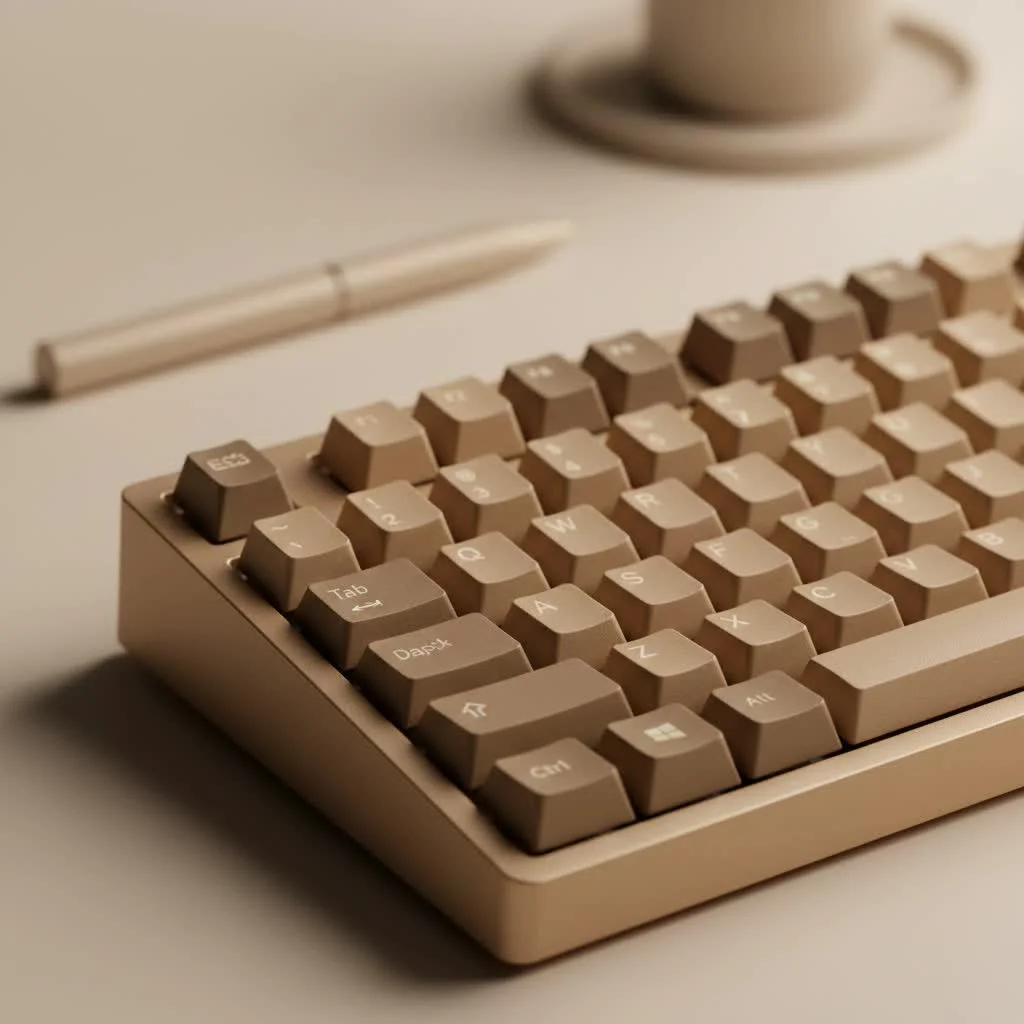
A linear mechanical keyboard provides a smooth, consistent keystroke without any tactile bump or audible click, making it ideal for competitive gamers, speed typists, and users who prioritize quiet operation and reduced finger fatigue. These keyboards feature switches that travel directly from the top to the bottom of the press, offering rapid actuation and a fluid typing experience. This design makes them a top choice for those seeking an unadulterated, buttery-smooth interaction with their input device.
The Heart of the Keyboard: Understanding Linear Switches
At its core, a linear switch is defined by its smooth, consistent travel from the very top of the press to the bottom. Unlike its tactile or clicky counterparts, there’s no noticeable “bump” or audible “click” to interrupt your finger’s journey. Imagine pressing a key and experiencing a single, uninterrupted downward motion, where the force required remains constant or increases gradually until you “bottom out.” This seamless action is what gives the linear mechanical keyboard its distinctive feel. For browse all reviews articles on this site.
Think of it this way: when you press a key with a linear switch, it’s like a perfectly paved highway – no speed bumps, no detours, just a straight shot to your destination. This consistent force profile across the entire keystroke is a deliberate design choice, prioritizing fluid motion above all else. This design principle is fundamental to the appeal of a linear mechanical keyboard.
Why Go Linear? The Unbeatable Advantages
The allure of the linear mechanical keyboard isn’t just about simplicity; it’s about performance and experience. Many users find a range of compelling benefits that make linear switches their go-to choice.
Speed and Responsiveness
For competitive gamers, especially in fast-paced genres like FPS or MOBA, speed is king. Linear switches excel here because their unimpeded travel allows for lightning-fast actuation and rapid, repeated keystrokes. There’s no tactile bump to overcome, meaning your finger doesn’t have to push past a resistance point before the key registers. This can translate into quicker reaction times and more fluid in-game movements. “When milliseconds matter, the unhindered travel of a linear switch can make all the difference in competitive gaming,” says Dr. Anya Sharma, a renowned ergonomics and input device specialist. This makes the linear mechanical keyboard a top choice for those seeking an edge.
Quiet Operation
In shared workspaces, during late-night gaming sessions, or when streaming, noise can be a major concern. Linear switches are generally the quietest of the mechanical switch types. While the sound of bottoming out still exists (when the keycap hits the keyboard plate), it’s far less pronounced than the sharp “click” of a clicky switch or even the subtle “thock” of some tactile switches. This makes a linear mechanical keyboard a considerate choice for environments where discretion is valued. Many users also employ modifications like O-rings or switch films to further dampen the sound, achieving an almost whisper-quiet typing experience.
Reduced Finger Fatigue
|
Our Picks for the Best Mechanical Keyboard in 2026
As an Amazon Associate I earn from qualifying purchases.
|
||
| Num | Product | Action |
|---|---|---|
| 1 | Redragon Mechanical Gaming Keyboard Wired, 11 Programmable Backlit Modes, Hot-Swappable Red Switch, Anti-Ghosting, Double-Shot PBT Keycaps, Light Up Keyboard for PC Mac |

|
| 2 | Logitech MX Mechanical Wireless Illuminated Performance Keyboard, Tactile Quiet Switches, Backlit Keys, Bluetooth, USB-C, macOS, Windows, Linux, iOS, Android, Metal, Graphite |
|
| 3 | AULA F75 Pro Wireless Mechanical Keyboard,75% Hot Swappable Custom Keyboard with Knob,RGB Backlit,Pre-lubed Reaper Switches,Side Printed PBT Keycaps,2.4GHz/USB-C/BT5.0 Mechanical Gaming Keyboards |
|
| 4 | EPOMAKER x Aula F75 Gasket Mechanical Keyboard, 75% Wireless Hot Swappable Gaming Keyboard with Five-Layer Padding&Knob, Bluetooth/2.4GHz/USB-C, RGB (Light Blue, LEOBOG Reaper Switch) |
|
| 5 | AULA F99 Wireless Mechanical Keyboard,Tri-Mode BT5.0/2.4GHz/USB-C Hot Swappable Custom Keyboard,Pre-lubed Linear Switches,RGB Backlit Computer Gaming Keyboards for PC/Tablet/PS/Xbox |
|
| 6 | RK ROYAL KLUDGE R98 Pro Wired Mechanical Keyboard, 96% Creamy Gaming Keyboard RGB Backlit with Number Pad and Volume Knob, Gasket Mount, MDA Profile PBT Keycaps, Hot Swappable Pre-lubed Linear Switch |
|
| 7 | SteelSeries USB Apex 5 Hybrid Mechanical Gaming Keyboard – Per-Key RGB Illumination – Aircraft Grade Aluminum Alloy Frame – OLED Smart Display (Hybrid Blue Switch) |
|
| 8 | Womier S-K80 75% Keyboard with Color Multimedia Display Mechanical Gaming Keyboard Creamy Sound, Wired Hot Swappable Gasket Mount RGB Custom Key board, Pre-lubed Stabilizer for Mac/Win, Black Kanagawa |
|
| 9 | RK ROYAL KLUDGE S98 Mechanical Keyboard w/Smart Display & Knob, Top Mount 96% Wireless Mechanical Keyboard BT/2.4G/USB-C, Hot Swappable, Software Support, Creamy Sounding, 98 Keys |
|
| 10 | AK96 Smart Mechanical Keyboard Gaming, 96 Keys Full Size with LED Colorful Backlit, Clicky Creamy Sounding, USB Wired Computer Keyboard with Volume Knob for PC, Mac, Windows(Grey) |
|
The consistent and often lighter actuation force of many linear switches can significantly reduce finger fatigue during prolonged typing or gaming sessions. Without having to repeatedly push over a tactile bump, the force exerted by your fingers is more uniform. This can make long hours at the keyboard feel less strenuous, allowing you to maintain comfort and efficiency. A linear mechanical keyboard helps maintain consistent pressure, reducing the strain on your digits.
Smooth Typing Experience
Beyond speed and quietness, many enthusiasts simply adore the inherent smoothness of a linear switch. The effortless glide creates a satisfying, almost frictionless sensation with each press. This can lead to a more enjoyable and fluid typing experience, almost as if your fingers are dancing across the keys. For those who appreciate a seamless interaction with their input device, the linear mechanical keyboard offers an unmatched feel.
Linear vs. The World: A Comparison of Switch Types
Understanding linear switches often becomes clearer when contrasted with their mechanical brethren: tactile and clicky switches. Each offers a distinctly different user experience.
Linear vs. Tactile: The “Bump” Factor
Tactile switches introduce a noticeable “bump” partway through the keystroke, providing physical feedback that indicates when the key has actuated (registered). This bump is often appreciated by typists as it helps confirm a keypress without needing to bottom out the switch. However, for some gamers or rapid typists, this bump can be perceived as an impedance, slightly slowing down rapid successive key presses. The linear mechanical keyboard, in contrast, offers no such interruption.
Linear vs. Clicky: The “Sound” Factor
Clicky switches take the tactile bump a step further by adding a distinct, audible “click” at the actuation point. This sound is often reminiscent of old typewriters and provides maximum sensory feedback. While incredibly satisfying for some, the loud nature of clicky switches can be disruptive in many environments. Linear switches offer the exact opposite: a quiet, unadorned press. If you value silence and an unobtrusive experience, the linear mechanical keyboard is your champion.
Choosing the Right Switch for Your Needs
- Gaming: Linear switches are generally favored for competitive gaming due to their speed and smooth, uninterrupted travel.
- Typing: Tactile switches are often preferred for typing as the bump provides useful feedback. However, many fast typists still opt for linear switches for their fluidity and reduced fatigue.
- Hybrid Use: If you game and type extensively, a linear switch offers a versatile balance, performing admirably in both scenarios, especially if you prioritize a quieter setup. A well-chosen linear mechanical keyboard can serve you across diverse tasks.
Popular Linear Switches You Need to Know
The market for linear switches is incredibly rich and diverse, offering a spectrum of experiences. Here are some of the most popular and well-regarded options for your linear mechanical keyboard:
- Cherry MX Red: The quintessential linear switch. With a light 45g actuation force and smooth travel, it’s often the default choice for those new to mechanical keyboards and remains a solid all-rounder for both typing and gaming.
- Gateron Red & Yellow: Gateron Reds are similar to Cherry MX Reds but are often praised for being slightly smoother and more affordable. Gateron Yellows, particularly the G Pro Yellows, are a community favorite, known for their slightly heavier spring (around 50g-55g) and incredible smoothness, often coming factory-lubed for an excellent out-of-the-box experience.
- Speed-Focused Switches: Cherry MX Speed Silver & Kailh Speed Silver: Designed specifically for quick reactions, these switches feature a shorter actuation distance (e.g., 1.2mm for Speed Silvers compared to 2.0mm for standard Reds). This means the key registers with less travel, making them incredibly responsive for competitive gaming. Kailh Speed Silvers offer a similar feel at a more budget-friendly price.
- Enthusiast Favorites:
- Gateron Ink Black V2: A premium linear switch cherished for its deep sound profile, exceptional smoothness, and elegant appearance. Often considered one of the best “stock” linear switches available.
- Akko V3 Creamy Yellow Pro: A fantastic budget-friendly option, offering impressive smoothness and a pleasing sound profile, especially when factory-lubed.
- Durock Linear Switches: Known for their excellent smoothness and tight tolerances, Durock switches are a popular choice for custom builds, often seen as a superior alternative to some traditional options.
actuation force (the pressure needed to register a keypress) and total travel distance vary between switches, subtly influencing the feel. Exploring these popular options will give you a great starting point for your linear mechanical keyboard journey.
Customizing Your Linear Experience: Tips for Enthusiasts
One of the greatest joys of the mechanical keyboard hobby is customization, and linear switches are a fantastic platform for modding.
Lubing Your Switches: Enhancing Smoothness
Even the smoothest stock linear switches can be improved with lubrication. Applying a thin coat of specialized lubricant (like Krytox 205g0) to the switch stem and housing significantly reduces friction, eliminates scratchiness, and refines the sound profile. The process for lubing linear switches is generally considered less complex than for tactile or clicky switches, making it a great entry point into keyboard modding. The result is an even more blissful, effortless feel for your linear mechanical keyboard.
Hot-Swappable Boards: The Freedom to Experiment
If you’re unsure which linear switch is right for you, or if you simply love to experiment, a hot-swappable keyboard is a major upgrade. These boards allow you to easily pull out and replace switches without soldering, giving you the freedom to try different linear types until you find your perfect match. This flexibility is invaluable for truly personalizing your linear mechanical keyboard.
Keycaps: Aesthetics and Feel
While keycaps don’t change the switch’s fundamental feel, they play a huge role in the overall typing experience and acoustics. Different profiles (e.g., Cherry, OEM, SA, XDA) and materials (ABS, PBT) can alter how your fingers interact with the keys and influence the sound of bottom-out. Experimenting with keycaps is another enjoyable way to fine-tune your linear mechanical keyboard.
Choosing Your Perfect Linear Mechanical Keyboard: A Checklist
Selecting the right linear mechanical keyboard involves considering a few key factors:
- Primary Use: Are you a dedicated gamer, a prolific typist, or a professional who needs a quiet yet responsive board?
- Actuation Force Preference: Do you prefer a lighter press (e.g., 45g Cherry MX Red) for effortless speed or a slightly heavier one (e.g., Gateron Yellow) for more intentional keystrokes?
- Budget: Linear switches and keyboards come in a wide range of price points. Determine what you’re comfortable spending.
- Build Quality and Features: Do you want a hot-swappable board? RGB lighting? A specific form factor (full-size, TKL, 60%)?
- Sound Profile: Even though linears are quiet, some are “thockier” and others “clackier” depending on materials and mods. Listen to sound tests if possible.
Frequently Asked Questions about Linear Mechanical Keyboards
Are linear switches only for gaming?
No, while linear switches are highly popular among gamers for their speed, they are also an excellent choice for typists and general computer users who prefer a smooth, consistent, and quiet keystroke. Many find them less fatiguing for long typing sessions.
Are linear switches quiet?
Compared to tactile and especially clicky switches, linear switches are significantly quieter. They lack the tactile bump and audible click of other switch types, making them ideal for shared spaces or quiet environments. The primary sound often comes from the keycap bottoming out, which can be further reduced with modifications like O-rings.
Can I lube my linear switches?
Absolutely! Lubing linear switches is a common modification that can dramatically improve their smoothness, reduce spring ping, and refine their sound profile. The process is generally straightforward and highly recommended for enthusiasts looking to enhance their typing experience.
What’s the best linear switch for beginners?
For beginners, Cherry MX Red or Gateron Red switches are often recommended. They offer a classic, light, and smooth linear feel that serves as an excellent introduction to the linear mechanical keyboard experience without being overly sensitive or heavy.
Do linear switches improve typing speed?
For some users, yes. The smooth, uninterrupted travel of linear switches can allow for faster and more fluid key presses, potentially leading to increased typing speed, especially after getting accustomed to the lack of tactile feedback. It largely comes down to personal preference and adaptation.
Conclusion: Embrace the Flow, Master the Board
The linear mechanical keyboard offers a unique and highly refined typing and gaming experience. With their consistent, smooth travel, quiet operation, and potential for exceptional speed, linear switches have carved out a significant niche in the mechanical keyboard community. Whether you’re a seasoned enthusiast looking for the next level of smoothness or a newcomer seeking a comfortable and efficient input device, exploring the world of linear switches is a journey worth taking. At Yoasy.com, we believe that understanding your tools is key to mastering your craft, and with a linear mechanical keyboard, you’re not just getting a device – you’re embracing a philosophy of uninterrupted flow and precision. Happy typing, and may your keystrokes always be smooth!
Frequently Asked Questions
Are linear switches only for gaming, or can they be used for typing?
No, linear switches are not exclusively for gaming. While popular among gamers for their speed, they are also an excellent choice for typists and general computer users who prefer a smooth, consistent, and quiet keystroke. Many users find them less fatiguing for long typing sessions due to their uniform force profile.
How quiet are linear mechanical keyboard switches compared to other types?
Compared to tactile and especially clicky switches, linear switches are significantly quieter. They lack the distinct tactile bump and audible click of other switch types, making them ideal for shared spaces or quiet environments. The primary sound often comes from the keycap bottoming out, which can be further reduced with modifications like O-rings.
Is it beneficial to lube linear switches, and how is it done?
Absolutely! Lubing linear switches is a common modification that can dramatically improve their smoothness, reduce spring ping, and refine their sound profile. The process involves applying a thin coat of specialized lubricant, such as Krytox 205g0, to the switch stem and housing, and it is generally straightforward for enthusiasts.
Which linear switch is recommended for beginners entering the mechanical keyboard hobby?
For beginners, Cherry MX Red or Gateron Red switches are often recommended. These switches offer a classic, light, and smooth linear feel with an actuation force around 45g, serving as an excellent introduction to the linear mechanical keyboard experience without being overly sensitive or heavy.
Can using linear switches actually improve a user's typing speed?
For some users, yes, linear switches can potentially improve typing speed. The smooth, uninterrupted travel of linear switches allows for faster and more fluid key presses, which can lead to increased typing speed, especially after adapting to the lack of tactile feedback. This improvement largely depends on personal preference and user adaptation.
Get our weekly buyer guide
Practical specs, not advice. Unsubscribe anytime.
I absolutely love my new linear keyboard! The smooth, uninterrupted downward motion of the keys is incredibly satisfying. It’s so much quieter than my old membrane keyboard, which is perfect for my home office setup. I can type for hours without any discomfort, and it just feels premium.
As a programmer who types all day, I was looking for something to reduce finger fatigue, and a linear mechanical keyboard has been a game-changer. The consistent keystroke really does make a difference over long sessions. It took a little getting used to after years of clicky switches, but my hands feel much better at the end of the day.
I’ve been using a linear mechanical keyboard for a few months now, and it’s completely changed my gaming experience. The rapid actuation is no joke – my reaction times in FPS games have definitely improved. Plus, the quiet operation is a huge bonus since I often game late at night and don’t want to disturb anyone. Highly recommend for serious gamers!
I picked up a linear keyboard hoping for that ‘buttery-smooth’ feel, and while it’s mostly there, I do miss the tactile feedback from my old keyboard. It’s great for speed typing, but sometimes I bottom out too hard because there’s no indication of actuation. It’s a solid keyboard, just a personal preference thing.